Tuesday, June 30, 2020

Confederate flag over South Carolina + photos

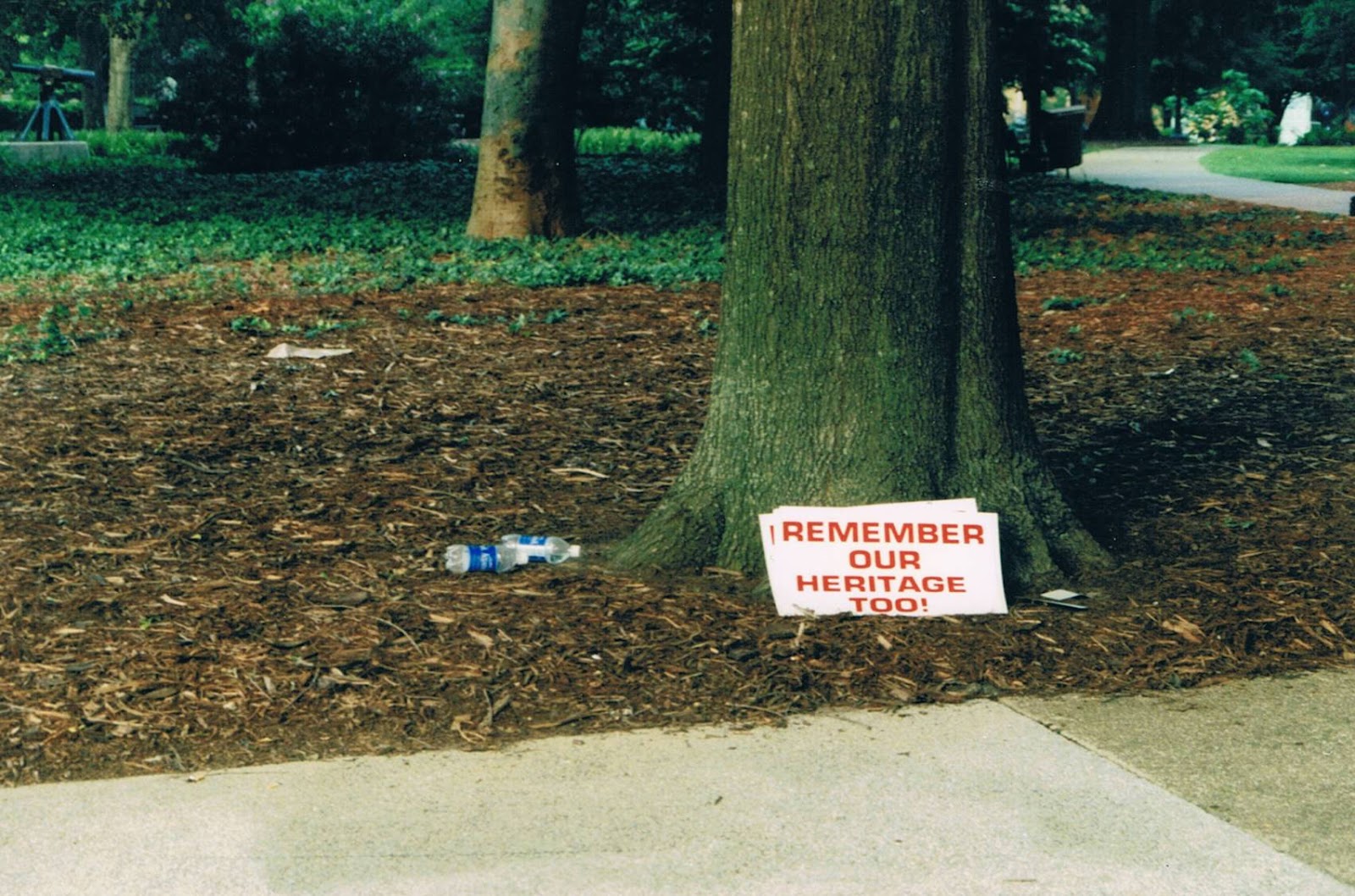
I originally wrote this article in the summer of the weird year 2000--remember the computer glitches that were supposed to happen but didn't and the 5 to 4 U.S. Supreme Court decision that put George W. Bush in the White House, and numerous nutty events in between, including this flag issue?--and I submitted it to the Arkansas Democrat-Gazette from my city of residence at the time, Columbia, SC.  The version below is one I submitted to 'em again in June 2010 for use in their Sunday editorial section--different editor by then--and again, no response.  With the 150th anniversary of the Civil War in progress, I'll probably try again with a new version of this article. 

[Update July 1, 2020, twenty years after the flag came down from atop the dome of the SC State House: See South Carolina State House entry on Wikipedia for updated flag placement history. It does not, however, mention civil rights activist Bree Newsome's climbing the 30-foot flagpole and pulling the flag down on June 27, 2015, ten days after Dylann Roof's murder of nine members of the  Emanuel African Methodist Episcopal Church in Charleston.]

Ten years ago I was walking across the arbor-like grounds of the South Carolina state capitol when I was stopped by a man wearing a denim shirt, blue jeans, well-used cowboy boots, and a battered cowboy hat.   He was about my age, 40-something, and resembled some farmers and farmhands I knew when I was growing up in Southeast Arkansas.  The large creases around his eyes told of years spent working in the sun

He nodded toward a patch of cleared ground and asked, “Is this where they’re gonna put that thing from Africa?”

In my Birkenstocks and wire-frame glasses, I may have looked like a New York liberal.   Being instead an Arkansas-bred liberal, I chose to interpret his derogatory reference to the African-American History monument as a good old boy’s request for factual information. My own history told me that responding indignantly—like a New York liberal—would have been merely rising to take the bait.

Although I knew the groundbreaking ceremony had occurred, I wasn’t sure where the monument would be constructed.    I glanced at the circular patch of dirt and said, “It looks like they’re gonna put something there.”


A moment passed.  I began walking off.  I heard him make a comment about “a 30-foot pole,” but he wasn’t speaking directly to me.  A woman was with him, his wife apparently, and she provided the necessary audience.  I kept walking.


     High above this brief encounter, on the single flagpole atop the capitol dome, two flags flew where three had been flying only a few weeks earlier.  The missing flag was the Confederate battle flag, which had flown above the capitol since 1962.  It was and is clear to most people that a Confederate flag does not belong on a flagpole on the grounds of any statehouse in the United States.  But the honor and glory of a defeated South can cloud some people’s thinking, especially in South Carolina, and especially after a viewing of Gone With the Wind, which was re-released in 1961, the Centennial of the beginning of the Civil War.


     When the rectangular Confederate flag atop the capitol dome came down on July 1, 2000, a slightly different Confederate battle flag—the “Southern Cross,” square with a white border, like the one shown flying above the panorama of dying and wounded Confederate soldiers in the Atlanta train depot scene in Gone With the Wind—was raised on a new flagpole on the north side of the capitol grounds.  It still flies there, next to the Confederate soldiers’ memorial monument “erected by the women of South Carolina” in 1879.  [Updates:  2015, 2018]


     The last bit of legislative compromise in the South Carolina statehouse that resulted in this rather meaningless change of location and pedigree for the Confederate flag concerned how tall the new flagpole should be.  One side said 20 feet, the other side said 30 feet.  I thought a compromise would have logically resulted in a 25-foot pole, but wasn’t sure and couldn’t tell by looking when I passed by it on that Sunday in July ten years ago.
I’d been walking across the capitol grounds that day on one of my frequent treks to the Capitol News Stand on Main Street. After I made my purchase and came out of the store, there was my “thing from Africa” acquaintance with his apparent wife. If he’d thought I was a New York liberal before, he now had evidence. I was carrying a copy of The New York Times.     

   I smiled a friendly smile—people in South Carolina, black and white, often smile and speak when passing one another on the street—and then a thought occurred to me. It was my turn to question him. Nodding toward the Confederate monument I said, “Is that a 30-foot flagpole?”


He answered in the affirmative, and then seized the moment he’d let pass earlier.  “But the flag oughta be up there—,” he turned and pointed toward the copper dome of the capitol, “on the top, where it belongs!”   I had seen and felt the antagonism of the “Keep It Flying” fanatics on the capitol grounds the day the flag on the dome came down and the other Confederate flag simultaneously went up next to the monument.

       There was no honor or glory in their rowdy behavior, or in the way they draped themselves in the Confederate flag.  It was merely more foolishness, like the foolishness of an all-white legislature that had resulted in the flag being placed atop the capitol dome 38 years earlier.  The only moment of truth I witnessed that day was the singing of “The Night They Drove Old Dixie Down,” written by Robbie Robertson, a Canadian who learned about the South by spending time in Arkansas with Levon Helm and his parents.  The song in no way suggests the South should have been the winning side in the Civil War.


My response to the man’s opinion that the Confederate flag should be on top of the capitol, flying beneath the United States flag and the South Carolina state flag, was to say “Some people don’t agree with that,” and then head on down the sidewalk.


As it turned out, the spot he asked me about is where the African-American History monument now stands.  The monument fits in well with its surrounding environment, pays tribute to both suffering and accomplishment, and is a long overdue testament to historical accuracy.


     None of these attributes applies to a Confederate flag officially sanctioned by the South Carolina legislature to fly on the statehouse grounds.  Thanks to a majority of South Carolina legislators, past and present, the flag has unfortunately become more of a racist symbol than it would have been otherwise.  Its proper place is in a museum along with the lesser known flags of the Confederacy, such as the “Stars and Bars” flag.  The 150th anniversary of the beginning of the Civil War next year would be a good time for the flag to be put in its proper place. 


See the Wikipedia article on Flags of the Confederacy, which includes mention of the South Carolina controversy.

Tuesday, February 4, 2020

Einstein, relative rest, and invariance in physics

Well, my 21st century writing about relativity finally did get published, on the "Voices" page of the Arkansas Democrat-Gazette, on November 3, 2007, almost exactly seven years after I started working on it and tried to interest the NY Times and Harper's magazine, without success. Publication on the Voices page meant there was no payment involved. It was really just a long letter to the editor labeled a "Guest Column." Here it is, slightly edited for clarity that was lacking in the published version:


Once upon a time, in the fall of 1977, I had the perfect job. I was a night watchman at the Old State House, usually working the 4 p.m. to midnight shift. My job was to make rounds through the building every hour. The job was perfect because I was a full-time student at UALR, and making a round took only ten minutes. In theory, I had 50 minutes out of each hour for studying.

In practice, I tended to read whatever interested me and to put off working on my homework as long as possible. I also had the luxury of being able to explore the Old State House all by myself whenever I felt like it. Procrastination, of course, is not an uncommon activity among college students. My happy situation was that I was getting paid for it—with a portion of your Arkansas tax dollar.

Or maybe it was your parents’ or grandparents’ dollar. Whatever the case may be, I’d like to now offer a little in the way of a return on that 30-year investment. I’d like to pass along a little bit of scientific knowledge.

During the fall of 1977, I was taking a beginning class in relativity and quantum mechanics. A good deal of my extracurricular reading during the evenings at the Old State House involved those subjects. Among other things, I was trying to find out if relativity really should be associated with the saying “It’s all relative.” I’d read that statement in a newspaper article about the virtuoso violinist and former child prodigy Yehudi Menuhin, who was asked what he’d learned from his acquaintance with Albert Einstein. Menuhin claimed to have learned from Einstein the same thing everyone else had learned, namely that “everything is relative.”

What I’ve learned over the years is that Einstein’s theory means the opposite of what it sounds like it means. When I started teaching physics about ten years ago, I came up with a way of paraphrasing the usual textbook description of the two ideas Einstein used in creating his theory. The ideas, or postulates, can be stated as 1) the laws of physics are not relative, and 2) the speed of light is not relative.

Those are the requirements that went into relativity. In actually finding equations for laws that satisfy these ideas, Einstein rewrote Newton’s laws of motion, simplified the laws of electricity and magnetism, and discovered several new laws, the most well known of which is the equivalence of energy and mass, E = mc2.

Besides the laws themselves, other mathematical entities are invariant in relativity. In particular, space, time, and the speed of light combine together in a simple equation for an invariant quantity called “proper time.” (This is a mistranslation from the French word propre, meaning “own”.) Proper time is the time you read on your own watch. Since you and your watch never move relative to each other, you never observe your own watch to speed up or slow down--contrary to the popular misconception of time slowing down the faster you travel. The slowing down of time is only valid when you compare your time to the time of the clocks in another rest frame, such as the one you left when you went moving off on your own. "Moving on your own," however, is just like not moving at all. That is the real message of relativity.

Relativity is not the name Einstein chose for his theory. He would have preferred it to be called the theory of invariants. This misnaming can be blamed on several of Einstein’s older contemporaries, including the French mathematician Henrí Poincaré and the German physicist Max Planck. Einstein unfortunately in his first relativity paper in 1905 used the accepted terminology of the time and called his first postulate "the principle of relativity". He later objected to his entire theory being called relativity, but he acquiesced to common usage among physicists in 1915 when he named his theory of gravity the general theory of relativity.

Gerald Holton, the grand old man of Einstein studies and an emeritus professor of physics at Harvard, wrote something of an off-the-beaten-path book published in 1996 called “Einstein, History and Other Passions.” Holton neatly summarizes the relative/relativity name confusion: “The cliché became, erroneously, ‘everything is relative’; whereas the point is that out of the vast flux one can distill the very opposite: ‘some things are invariant.’”

So, “everything is relative” may be a balm of hurt minds, but physicists are looking for those things in the universe that are invariant. Invariance, by the way, is related to symmetry, but you’ll have to look that up for yourself.


Update March 14, 2012, Einstein’s 133rd birth anniversary:

Relativity is more about relative rest than relative motion. The question is, can you put yourself in any situation where you can actually say you're NOT at rest? In other words, can you do experiments that will show you are moving?

Constant velocity, with which we are all quite familiar, is just like not being in motion, and so is constant acceleration, as long as it’s either  straight line acceleration or centripetal acceleration (such as going around a curve in a car, or being on an orbiting planet or, in your imagination, on an orbiting electron). The forces we feel during either type of acceleration are, in general relativity, attributable to an equivalent acceleration due to a gravitational field.

There is one type of motion that can’t be considered equivalent to being at rest.  If you had the proper equipment you could do measurements right now that would tell you you’re moving. Yes, being “at rest” on the surface of the earth is the exact type of motion that can’t be considered rest, because Earth is rotating. Earth’s revolving around the sun is relative motion, but earth’s rotation isn’t.  It can be measured by a Foucalt pendulum.  (The large pendulums you see in some science museums are Foucalt pendulums—okay, you could say “pendula” if you insist. They swing in one plane of motion while the earth rotates under them.  Their pivots must be as friction-free as possible to keep them swinging with the same amplitude for a long time.)

Some physicists think (and write and calculate) that even rotation is covered by general relativity as a case of being at rest. I’ll have to get back to you on that, due to my relative ignorance on the subject.

Wednesday, January 1, 2020

Huey Long Spends a Night in Pine Bluff


“Kingfish” Huey Long Spends the Night
At 4006 Cherry Street in Pine Bluff

By David Trulock

Senators Huey P. Long of Louisiana and Hattie W. Caraway of Arkansas spent the first day of August in 1932 speaking in five south Arkansas cities on the first leg of an eight-day campaign to promote Mrs. Caraway’s re-election. Pine Bluff was their final stop on that hot August day that had turned to evening by the time they spoke to a large crowd at the Missouri Pacific Park on East Sixth Avenue.

After giving their speeches, both Caraway and Long repaired to the Hotel Pines.  In those days, even a venerable establishment like the Pines was still dependent on ceiling fans and oscillating fans for cooling.  Mrs. Caraway presumably spent the night there, along with others traveling in the political caravan.  According to the next day’s newspapers, however, one of Huey Long’s supporters offered him a better deal—a cooler place to sleep—and he accepted.

Pre-history of 1932 Campaign

Hattie Caraway had only recently been appointed to fill the Senate seat of her husband, Thaddeus Caraway, who’d died unexpectedly on November 6, 1931.  The appointment also involved a special election.  An article written some fifty years later by Patrick Kelly, a freelance journalist from Magnolia, described the nature of the election: [i]

Governor Harvey Parnell appointed Mrs. Caraway to take his [Mr. Caraway’s] seat in the Senate, pending a special election in January 1932.  Custom dictated, however, that the governor’s appointee be given the Democratic nomination (hence, victory) for that election.  After some infighting among the Democrats, Mrs. Caraway was nominated in December, and on January 12, 1932, she was elected against token opposition.


Then, very unexpectedly, Hattie Caraway decided to run against real opposition in the real election, or what amounted to the real election, the Democratic primary of August 9, 1932.  She and Huey Long had seats next to each other in the senate chamber, and were in agreement on most issues, but, according to Caraway’s published diary, Silent Hattie Speaks, she was initially not a fan of his loud, long-winded oratory.  Nevertheless, when Long offered to help her on what became a statewide whirlwind campaign —“the first Arkansas had ever seen,” according to Patrick Kelly—she could hardly refuse.

Caraway and Long in Pine Bluff

Long, of course, was doing most of the speaking on the tour.  He and his entourage also introduced into the campaign a portable public address system known as the sound truck, of which he had two.  While one truck was amplifying sound (recorded music was used prior to the speeches), the other would travel to the next town on the schedule and be ready when Long and Caraway arrived.  Long also provided thousands of campaign leaflets carried in two vans that followed the same leapfrog pattern as the trucks.

On that first day of August, when the caravan made stops in Magnolia, El Dorado, Camden, Fordyce and Pine Bluff, the temperature had reached 103, according to the next morning’s Pine Bluff Daily Graphic, which opened its banner-headlined article about Long and Caraway’s visit to the city by discussing the fast-paced nature of the campaign tour, while also giving a nod to the heat at the end of the second paragraph:

Kingfish Huey P. Long of Louisiana roared into Pine Bluff on a tailwind last night to climax the first day of his joint stumping tour with Mrs. T. H. Caraway, telling an enormous crowd of southeast Arkansas residents that “the classes are trying to destroy this little woman who is the friend of the masses.”

For nearly an hour the fiery Louisiana senator, who dropped eight other campaigns in which he is interested in various parts of the south to pick up the standard of the nation’s first woman senator, roared appeals in her behalf to a sweating but thoroughly interested audience.


Long used the “little woman” epithet to refer to Hattie Caraway throughout the campaign.  That would not be acceptable today, even though it was literally true in Caraway’s case.  On the other hand, Long’s catchphrases regarding the classes versus the masses are very much in harmony with today’s discussions of income inequality, except no one today could match Long in his fervent use of Biblical quotations to support the cause.

The Pine Bluff Commercial, the afternoon paper, opened its August 2nd article about the Caraway-Long campaign tour with a report on Long’s speech given that morning in Stuttgart.  The news of the previous night’s speeches in Pine Bluff, having been reported by the Graphic that morning and thus being old news by afternoon, was relegated to the middle of the article.

But perhaps there was another reason the Commercial was less effusive than the Graphic about the presence of  Huey Long in Pine Bluff. The editor of the Graphic, Edgar B. Chestnutt, was responsible—or at least claimed responsibility—for bringing Long to Pine Bluff.  In a page-one sidebar to the main article about Long’s and Caraway’s speeches, the Graphic reported that Chestnutt, “at whose invitation the Kingfish visited here,” made a presentation to Long after the speeches were over, saying:  “Senator … you have a nickname that never has been formally and officially given to you … we usurp the authority somewhere to formally and officially name you ‘the Kingfish.’”

The article continues:  “Wherewith he [Long] was presented with a beautiful floral design of a large fish, wearing a gold crown, the idea of Ben A. Pearson of the Pearson Flower and Garden Shop.”

Where Huey Long Spent the Night

Despite the differences in their coverage of the Caraway-Long political speeches, both the Graphic and the Commercial ended their articles with a few paragraphs on where Long spent the night of August 1st.

The Commercial:

At the conclusion of his speech he retired to the Hotel Pines here and from there went to the home of Clarence Philpot.

He became acquainted with Mr. Philpot while the paving contractor was engaged in work on Louisiana highways, and appeared in Mr. Philpot’s behalf after paving equipment had been damaged by dynamite explosion on a Louisiana job, getting help for Mr. Philpot in the form of a state appropriation to partially cover the damage.

The Graphic:

Immediately after the speaking, Sen. Long returned to the Pines Hotel, where he had been making headquarters, shook hands with many of his friends, and went out to be the guest for the night of C. E. Philpot, Pine Bluff contractor, whose equipment was dynamited by radicals in Louisiana and for whom Sen. Long personally appeared before the legislature and obtained financial restitution for Mr. Philpot.

“Have you got a sleeping porch, Mr. Philpot?” asked the senator when extended an invitation to be his house guest.

“Yes, a nice cool one,” replied the host.

“Let’s go,” answered the Kingfish, and he pushed through the crowd in his room and disappeared.


Huey P. Long apparently had a knack for disappearing right after his speeches.  The Graphic concluded its sidebar about Long being presented the “Kingfish” floral bouquet with this description of his response:  “‘Thank you, put it in the car and let’s take it to the hotel,’ the Kingfish said, elbowing his way through the crowd.”


Addendum

Clarence Philpot lived at 4006 Cherry Street in 1932, in the house my family later lived in (1963-2007).  For a photo showing the sleeping porch see “When We Moved To Pine Bluff,” in the Spring 2014 issue of the Quarterly.  The caption on the photo referred to the sleeping porch as a sunroom, to Huey Long as being Louisiana’s governor when he was “rumored” to have slept there, and to Clarence Philpot as a former Jefferson county judge.  [In this web version of the article, the photo is shown below. It was taken in August or September of 1963 by my dad, Walter Trulock III.]

In the present article, each of these misidentifications has been corrected except the last:  Clarence’s older brother Charles M. Philpot was the Jefferson County judge, not Clarence.  As county judge from 1910 through 1916, Charles was involved with the construction of the Dollarway in 1913-14.

Charles Philpot died at his daughter’s home in Birmingham, Alabama in 1935[ii], the same year Huey Long was assassinated by the son a political rival.  Clarence Philpot died in the house at 4006 Cherry Street on August 14, 1937, at age 71, of a heart attack brought on by injuries he sustained when hit by a car in Moscow (Arkansas) in late 1936.[iii]


[i] “Whirlwind Campaign Sent Caraway to Senate,” Arkansas Gazette, December 19, 1982, page 1C.
[ii] “Judge Philpot Dies at Home of His Daughter,” Pine Bluff Commercial, March 30, 1935, page 1.
[iii] “C. E. Philpot Dies of Heart Attack Today,” ibid, August 14, 1937, page 1.

Tuesday, December 17, 2019

Walter Trulock III's return to Pine Bluff


Published in the December 2005 issue of the Jefferson County Historical Quarterly.

Wednesday, December 4, 2019

TAPES and Carl Bell of Pine Bluff, Arkansas

From the Winter 2019 issue of the Jefferson County Historical Quarterly.


The Story of TAPES and Carl Bell
Of Pine Bluff

By David Trulock

Fifty years ago, a group of volunteers recruited by Carl Bell, a pump and pipe salesman at Soltz Machinery & Supply in Pine Bluff, was in the early stages of recording and sending taped music to soldiers in military hospitals in Vietnam and elsewhere.  The volunteers loaned their albums to Carl, who recorded them onto blank tapes. Volunteers also donated money to buy blank tapes in bulk quantities and to pay for shipping of recorded tapes.

Carl began taping in 1969 using 3-inch reels, but later changed over to cassettes.  He and his volunteers became known as “TAPES of Pine Bluff, Arkansas.” In the early 1970s, TAPES sent thousands of tapes of all types of music—rock, country-western, folk, soul, blues, classical, “easy-listening”—to military hospitals and drug treatment centers not only in Vietnam, but also in Guam, Okinawa, Taiwan, the Philippines, and South Korea. The USS Sanctuary (a hospital ship) and Navy hospitals in San Diego and Oakland, California, were also recipients of tapes from TAPES.

I joined the group in early 1971, when I was in the 11th grade at Pine Bluff High School.  Carl and his wife, Jane Glasscock Bell, had moved to Pine Bluff from Shreveport in 1953, and had become friends with my grandparents, Walter Jr. and Frances Andrews Trulock. We were all members of First Presbyterian Church. My grandfather knew I listened to a lot of music and I had albums to loan. Later, my younger brothers also loaned albums to TAPES.

Carl was prolific in writing letters of all kinds, including personal notes, lists of particular albums requested by hospitalized soldiers, and updates on the number of tapes sent out and where they were sent.  He also provided members of the group with photocopies of thank-you notes he received from chaplains, Red Cross officials, and the soldiers themselves.  He TYPED all the letters, lists, and updates on a manual typewriter, making multiple carbon copies in the process.  Thinking about this today, I realize typing letters was one way for him to pass the time while he was taping.

“Sending 2,884 Tapes to ‘Nam and the World”

One of his updates during the early days of TAPES was a three-page, single-spaced description of the work done by the group up to the end of August 1972. (Coincidentally, that’s when I turned 18 and had to register for the draft. I wasn’t drafted, and don’t recall being very worried about it, maybe because of a high lottery number, or just fewer people being drafted by then, or both.) The title Carl gave to his summary is “The Story of TAPES: Sending 2,884 tapes to ‘Nam and the World.”  He had a rather quirky way of writing, but that won’t show up until later in this story. Here’s the first paragraph of his summary:

It all started in Danang during June of ’69, when the Senior Chaplain, Lieutenant Commander Glenn Thomson, told a doctor that they had six Panasonic 3-inch reel tape players, but no tapes for the patients. “We” were volunteered although we’d been away from music for quite a few years, and never taped. So, the portable stereo turntable was adapted so it would play into a 3-inch Craig machine.  Also adapted the TV and a radio to tape programs. A station in Little Rock put on a special program for us—an hour covering every request we’d had from ‘Nam, as did a country/western station in Jacksonville, Arkansas.

The doctor mentioned near the beginning of the paragraph was Carl’s son, Carl Bell, Jr., known as Rick, a Navy surgeon assigned to the Navy hospital in Danang. At the time Carl wrote the summary, Rick had just returned to Pine Bluff with his new wife Lee, a nurse from Taiwan, to open his own practice.  He later worked as an emergency room doctor at Jefferson Regional Medical Center.

Rick’s return home after four years was probably the reason his dad deemed it appropriate to provide a summary of the work TAPES had done up to that point. After noting that 300 tapes (3-inch reels) were sent to the Navy hospital in Danang before it closed in 1970, and that most of those tapes were of inferior quality due to the improvised setup for recording them, Carl wrote:

They did get some good tapes as Sue Trulock loaned me her 230 Sony R/R … but I’d break out in a sweat when using her equipment, so I bought a 230 myself—seeing there was a future in our “business”.  Over one million feet of tape has gone across the heads on that Sony reel/reel machine. We now have a nearly new turntable, very good receiver/amplifier, and a Sony/Dolby cassette recorder, all wired to another receiver and speakers in the living room, where my wife can tune in or out—mostly out, with all that rock music!
The Dolby-B noise reduction system—which eliminates the high-frequency “hiss” that was characteristic of cassette recordings at the time—had just been introduced in the stereo cassette recorder market in the early 1970s, and Carl jumped on that bandwagon without hesitation.  Advent, the company that made the famous Advent speakers and a high-quality manual turntable was the first to make a cassette recorder with Dolby-B noise reduction, in 1970.  Sony and other companies were quick to follow, however.  [Correction: the "high-quality manual turntable" wasn't made by Advent, it was the AR turntable, made by Acoustic Research, but Henry Kloss was the audiophile genius behind the products of Advent and AR, as well as others he founded later.] 

Taping for TAPES

At the time Carl sent out his three-page summary to his contacts at military hospitals and at the Red Cross (with copies sent to members of TAPES), I was entering Hendrix College as a freshman, and had received as a high school graduation present from my parents a stereo system I’d picked out.  It included a Sony cassette deck with Dolby-B, although I wasn’t able to get the top-of-the-line model that Carl bought for TAPES.  With this equipment, I went from loaning albums to making cassette tapes directly from my albums in my dorm room.

When I let Carl know I could make tapes myself, he sent me the letter below.  I’d previously asked him how to spell Rick’s wife’s name, so that’s what he’s referring to in the second sentence of the first paragraph.  Also, Raley’s House of Music, at 619 Main St., was owned by B. J. and Havis Raley, whom Carl refers to collectively as “Raley”. 

21 September
Hi’, Podner =
As soon as I recover from shock, will tell you just how much all of us appreciated your nice letter. Oh, it's “Lee”.
Looks like you're going first class, so we'll let you tape a wee bit for the Syndicate. I’m glad you did get the equipment outlined, and don't ever buy anything but the best from here on out. “Starters” just won't get it, as we always go up and that costs more money. I read every word in material sent, but I'm broke. The real list will be here in Rick’s last shipment, if and when it arrives: Taiwan prices on Sony, Panasonic, Marantz, and anything else you want. But, I've come out like a rose in dealing with Raley, as his repairs and help have offset quite a few fast bucks. He also loaned us over 200 albums off #1 shelf. True, I get treatment reserved for a few as he just couldn't loan out albums and still be in business. He didn't do it for me —did it for what I was doing.
I'm enclosing the master list of cassettes available, and would like for you to mark what albums you have and can handle. Plus, asking Jim Kennedy to mark his list — if he'll loan them to you or come and help tape. Please send it back after marked and I'll put DT and JK by your music available, as I'm doing on Tommy Brown’s collection. Then, when I get the requests marked on list being returned by Red Cross, U. S. Army Medical Center, Okinawa, I can make a list of your and Jim’s and send to you for recording on cassettes I'll send/tomorrow.
That hospital is a whopper, and they are delighted to hear that they can get cassettes for patients, and they have the players ready.
I'm sending you tomorrow via insured parcel post:
30 - C-60 tapes to start
60 - white labels to attach
30 - "Tapes" labels for side one of tape
30 - Poly boxes
1 - pen with waterproof ink

In event you've forgotten, I'll fix one tape like they want them. The RC folks say if Tapes’ label is on the white cassette label they don't walk, because when you remove the label it shows.
Good luck = thanks for taking the time = (signed) Carl Bell

Besides Jim Kennedy, Tommy Brown, and me, Jeff Smith from Pine Bluff was another Hendrix student who helped by loaning albums and making tapes.  (Tommy and Jeff are longtime readers and supporters of the Quarterly.)

When Carl sent me the letter, he also sent me his three-page update.  Here’s some more from that summary, which is dated 7 September 1972:

Before leaving Danang, Chaplain Thomson turned us over to Father Shamus Loftus at 95th Evacuation Hospital, as they were handling patients for Army, Navy, Marines, and what have you. We furnished them 120 more tapes—7” reels and cassettes … .
Then, Navy Hospital at Guam came into the picture. One of the men from nearby Grady, Arkansas, stepped on a mine at Danang and was sent there.  His uncle told us about him, so we wrapped him up with everything we could beg, borrow, or steal.  The Red Cross then set up a tape library, and we have furnished them 351 tapes to date.  We went to cassettes in December 1970.
Admiral James Kelly, then Chief of the Navy Chaplains in Washington, suggested Navy Hospital at Oakland—long-term patients. We’ve sent them 407 tapes. Best thing we heard from there was they lashed 40 amputees in wheelchairs in back of trucks, drove them up to the mountains, and they killed 20 deer for the hospital barbecue!
At the same time, Admiral Kelly suggested the USS Sanctuary (AH-17) in Danang Harbor. Chaplain Francis Craven wrote back we were an answer to a prayer, as they didn’t have cassettes for the patients aboard. They had reel-to-reel tapes for crew and officers, but nothing for on the wards. We got our tails in high gear during December 1970, and got them 200 cassettes before they left Danang in May 1971 to be decommissioned. …
When USS Sanctuary headed for home, they got us up a plaque and mailed from Hawaii, from officers, crew, and patients. Father Craven got a list of Army hospitals in ‘Nam from Martha Royse [of the Red Cross], so we wrote them, getting ten quick replies—“no tapes.” That seems to be the stock reply, and cannot understand why someone didn’t come up with tapes long before 1969. We understand radios have trouble down in the holds of ships, and around hospitals, so tapes are the thing for on the wards.  We’ve found out what it means when a fella gets a tape of his favorite music, whether it’s rock, country/western, popular, soul, blues, spirituals, classical or opera.
We now have over eighty 7-inch master reels with 12 albums or 8-tracks to the reel, about 960 selections … .

I guess most people reading this, but not all, remember having 8-track tapes. Some people may even remember having their own reel-to-reel recorders and players. A few albums were still available in reel-to-reel format in the early seventies—mainly classical music—and Carl was able to record from those also.  The reel-to-reel format fell out of fashion after Dolby noise reduction for cassettes became popular.

Those of us taping at Hendrix for the “syndicate” were mainly recording our own LPs that Carl already had on his 7-inch master reels.   Our purpose was to save him time.  He sent us the master list, and we picked out the ones we could record onto the blank 60-minute or 90-minute cassettes he provided.  We then labeled and boxed them, and would mail or take them to him in Pine Bluff.  One other person, Tom Hutchings, a junior at Pine Bluff High School, was doing the same thing at that time, which was probably the peak year of TAPES activity.

Contributors to TAPES

Among the things Carl included in his September 1972 three-page summary were lists of TAPES’ financial supporters and of people loaning albums, and a short comment on why TAPES was going to continue what it was doing even though the war was said to be winding down:


1972 contributors = Russell Law, Conroe, Texas; Miss Gladys Cole, Shreveport, Louisiana; Chester Perkins and Peg and Seth Keller, Laconia, New Hampshire; Joe Taylor, Wheeling, West Virginia; N. R. PA. C. 9-5, Milwaukee — the Navy Reserve, Public Relations; Mr. & Mrs. Walter Trulock Jr, Mrs. W. A. Barrow, Billy Bellamy, Mr. & Mrs. Jack Hatcher, Mrs. Jim Kennedy, Elizabeth Nunn, all of Pine Bluff — and Margaret Hutchings, also of Pine Bluff,  who just gave us 175 cassettes.
Those loaning material for us to put on master reels for future cassettes:  Ken Turner, Jim Kennedy, David Trulock, Tommy Brown, Pat Calkins, Raley’s House of Music, Dr. Robert Nixon, Bob Nixon, Jack Hatcher, Jr., Mr. and Mrs. Kayo Harris, Lt. Vernon Finley, Joe Faucett, Tom and Ann Hutchings, and Jane Bell . . . . . . Pat Brown’s 7” open reels of popular and classical music . . . . . . and great Christmas tapes.
1972 has been our biggest year — could double number of tapes sent any prior year; and they say things are unwinding! None of us feel our job has been finished . . . . . . . . . or even close to the end of the line. Too many fellas in hospitals . . . . . . . . not back home as yet.

Finally, here’s a thank-you letter, one of many written to Carl, thanking the supporters of TAPES.  It mentions a couple of supporters’ names not mentioned above.  The letterhead says “The American National Red Cross, Naval Hospital Long Beach, California 90801,” and the letter is dated 20 April 1972:

“Dear Tapes Friends:

“Still they come—the tapes, that is, and each day more and more patients are ‘discovering’ their favorites. We now have 4 cassette players and all are in use most of the time.

“‘Mr. Tapes’ through all of you is doing such a tremendous job of keeping a wonderful variety of tapes, and correspondence, coming that we are continually amazed.  To all of the people who have shared their recordings — Jim Kennedy, the Browns, Hatchers, Mrs. Bell, Pat Calkins, the Harris’s, D. Trulock, Jack Voris, Dr. Nixon, Lt. Finley, and certainly Judy [Carl and Jane’s daughter] and Raley’s House of Music — thanks!  Attached is a checked list of tapes that our patients have indicated they want you to put on your list when time and opportunity allow for more recordings.

“Of course, the above wouldn’t be possible if there weren’t people like the Kellers, Russell Law, LCDR Blomgren, Mr. Bellamy, Mrs. Barrow, Mrs. Trulock and Mrs. Bell who round up the blank cassettes for the recordings . . . . money, time and interest is never ending it seems.  Big bouquets to you all!

And to Tommy Brown and Carl Bell who do the ‘tuneful mechanical work.’  You are great—and very busy no doubt.  Deepest appreciation to you.

“We received the ‘Monkey Business’ calendar and it hangs in the recreation lounge on the Repose — they get a lot of laughs from it.

“Just talked with a young Army patient who recently arrived here from Vietnam.  He did not come back as a patient, but has since had a broken pelvis due to a vehicle accident here in California—so bed rest is the ‘medicine’ and today he is well armed with tapes for the next few days.

“There should be more letters from the fellows—they talk about doing it but sometimes are slow to follow through—you know how it is.

“Anyway, it’s good to talk with all of you and to know you are in the ‘cheering section’ for the hospitalized men and women.  THANKS A MILLION.

                                                                                                “Sincerely,
                                                                                                (signed) Martha L. Royce
                                                                                                Hospital Field Director”


After Vietnam

A peace agreement between the United States and North Vietnam was signed and American prisoners of war were released in January 1973 (although, of course, the war between North and South Vietnam didn’t end until 1975). After U. S. soldiers left Vietnam, Carl continued sending tapes to military hospitals in the U.S. and overseas. In April 1973, he mailed to TAPES supporters a list of hospitals that tapes had been shipped to so far that year.  A total of 315 tapes had been sent to: Clark Air Force Base, the Philippines; Navy hospitals in Guam, Long Beach, and San Diego; the Army Medical Center in Okinawa, the Army Hospital in Seoul; and, also in South Korea, the 43rd Surgical Field Hospital (a MASH unit). 

My main memory of visiting Carl at his and Jane’s home at 2105 Oak Street in Pine Bluff is of sitting in a chair in his bedroom where his taping equipment was, while he lounged crossways on his neatly made-up bed smoking a cigarette (with an ashtray beside him) while we talked.

Carl and Jane were both longtime smokers, and both suffered from health problems as a result.  They eventually quit, but at some point Jane had to have one lung removed, and in 1992, Carl suffered a stroke that made it difficult for him to talk—he couldn’t quite put the words together quickly or correctly. Oddly enough, judging from his smile and general attitude, he seemed happier after his stroke than in the few years before it. He died in 1994 and Jane died in 2002.

In 1944, when he was 34, Carl—who had registered for the draft in October 1940—was called up and received basic training at the Naval Training Center in San Diego. Afterwards he was assigned to the Naval Supply Depot at Mechanicsburg, Pennsylvania (where he got to know Seth Keller). In his TAPES summary written in September 1972, after noting that 188 tapes had been sent to the Naval Hospital in San Diego, he makes a comment in his typical abbreviated style about Navy boot camp: “I was at Boot in Dago in 1944, and they never lulled me to sleep with a tape of my favorite music!  Only music I heard was CADENCE!”